AI

Coming to Review Board: AI, EDA Review, Crucible Import

I feel like the world of code review has somewhat stagnated. Most people use a variation on GitHub Pull Requests, which slowly began to catch up to the kinds of features we have in Review Board, but never quite got there. Good enough for many, but could be better for most.

In a similar vein, the world of code review has stagnated in what and where people can review. You pretty much have to be on a bespoke Git-based service, which leaves out companies with decades of history backed on Subversion, Perforce, and others. And you’re limited to just reviewing source code, when there’s so much more that goes into a product.

We built Review Board at a time before pull requests and the prevalence of Git, a time when code review was barely a thought in the minds of most software developers. As the concepts we worked to pioneer began to take hold, and more solutions entered the market, we watched them begin to coalesce around an overly-simple model that left little room for the non-code assets that comprise so many projects. We watched as cloud-based solutions began to dominate and on-prem got left behind along with all those legacy customers.

And now we’re watching the older waves of on-prem solutions begin to disappear, leaving customers stuck. Watching the rise of AI-focused and AI-only solutions threaten further slop in projects, with minimal human oversight.

And with all this, whole industries of creators are still being passed over.

We’re building better solutions

We have a few major things in the works for Review Board I’m so happy to begin talking about:

AI functionality is coming, and we’re building it with humans in mind. We believe in building stronger engineering teams instead of replacing them with AI. I’ll be talking about what’s coming as we get closer to launch, but this isn’t just another “throw code at the AI and hope its feedback is worth it.”

EDA Design is a major new feature we’ve got in the prototype phase. It allows designs for schematics and PCBs to be viewed, analyzed, and diffed across revisions. We announced that today for anyone interesting in signing up for a beta.

Crucible Import is also in progress. For decades, many industries depended on Crucible for their development, but in 2028 Crucible will be dead. Review Board is a good, modern fit for Crucible users, and we’re making it easy to import your history and pick up where you left off. There’s no need to move away from Perforce, Subversion, or whatever else you’ve got, but at the same time you can begin to review code hosted on GitHub, GitLab, Jujutsu, or others. Crucible users can sign up for a beta.

And we’re staying on-prem. Others want to bring you into their fold so they can own your whole environment. We believe in the portability and choice of tools, on-prem or in the cloud, and are holding firm on that.
Coming to Review Board: AI, EDA Review, Crucible Import Read More »

AIs Don’t Take Showers

I enjoy my morning routine. Get up, wake to the world through the phone, nibble on some breakfast, and sit down at the computer. I like to remind my sleepy brain what I was working on the night before, skim through my notes, get all that mental context ready for the day.

Then I take a shower and let the stream of water ease my mind into a calm, zen-like state, free to let the thinkless thoughts flow.

That’s usually when a brilliant idea will pop into my head. Or when I realize what I did wrong last night. Or when I come up with a better way forward.

If not in the shower, maybe it happens in my late-night slumber, solutions through a mess of vivid dreams. But whether dreamland or my morning shower, this is when important insights usually come to me.

Insights that depend on the depth of my work, the mental context I’ve developed working through the nuances. Insights that come from letting my brain sit with the problem, exploring it while I’m off doing other things. Insights that come to me in the shower.

Now, AIs are a powerful tool. They can achieve wonders. They can write code faster than I can. They can explore concepts in a fraction of the time and teach them to me. They can catch what I might miss. They can even rewrite my codebase from Python to Go and back.

But AIs don’t take showers.

They don’t sit and think about the problem after the code has been written. They don’t wake up at 3AM with a sudden realization. They don’t debate with themselves over the what-ifs and maybe-if-I’s. They don’t have a conversation over coffee or a read through a thread that sparks a sudden “ohhhh!” moment.

Their human could do all that. But their human hasn’t spent time with the code the way the AI did, didn’t internalize the decisions, weigh the trade-offs. Their human won’t know the code as well as the AI did in the moments it was writing it, just hours ago.

The code the AI has since forgotten.

That code now simply exists, a relic of a process, waiting to be learned all over again by people who didn’t write it. There’s nobody left who remembers the hundreds of tiny decisions that led to the way it is now. Nobody who struggled and theorized and debated their way to something finally ready for review. Nobody to call up and ask why it was done this way and not that way.

The great cognitive debt fallout felt from every layoff, now applied to every code change in the product.

Anyway.

Something I was thinking about in the shower.

AIs Don’t Take Showers Read More »

Peer-Programming a Buggy World with ChatGPT AI

AI has been all the rage lately, with solutions like Stable Diffusion for image generation, GPT-3 for text generation, and CoPilot for code development becoming publicly available to the masses.

That excitement ramped up this week with the release of ChatGPT, an extremely impressive chat-based AI system leveraging the best GPT has to offer.

I decided last night to take ChatGPT for a spin, to test its code-generation capabilities. And I was astonished by the experience.

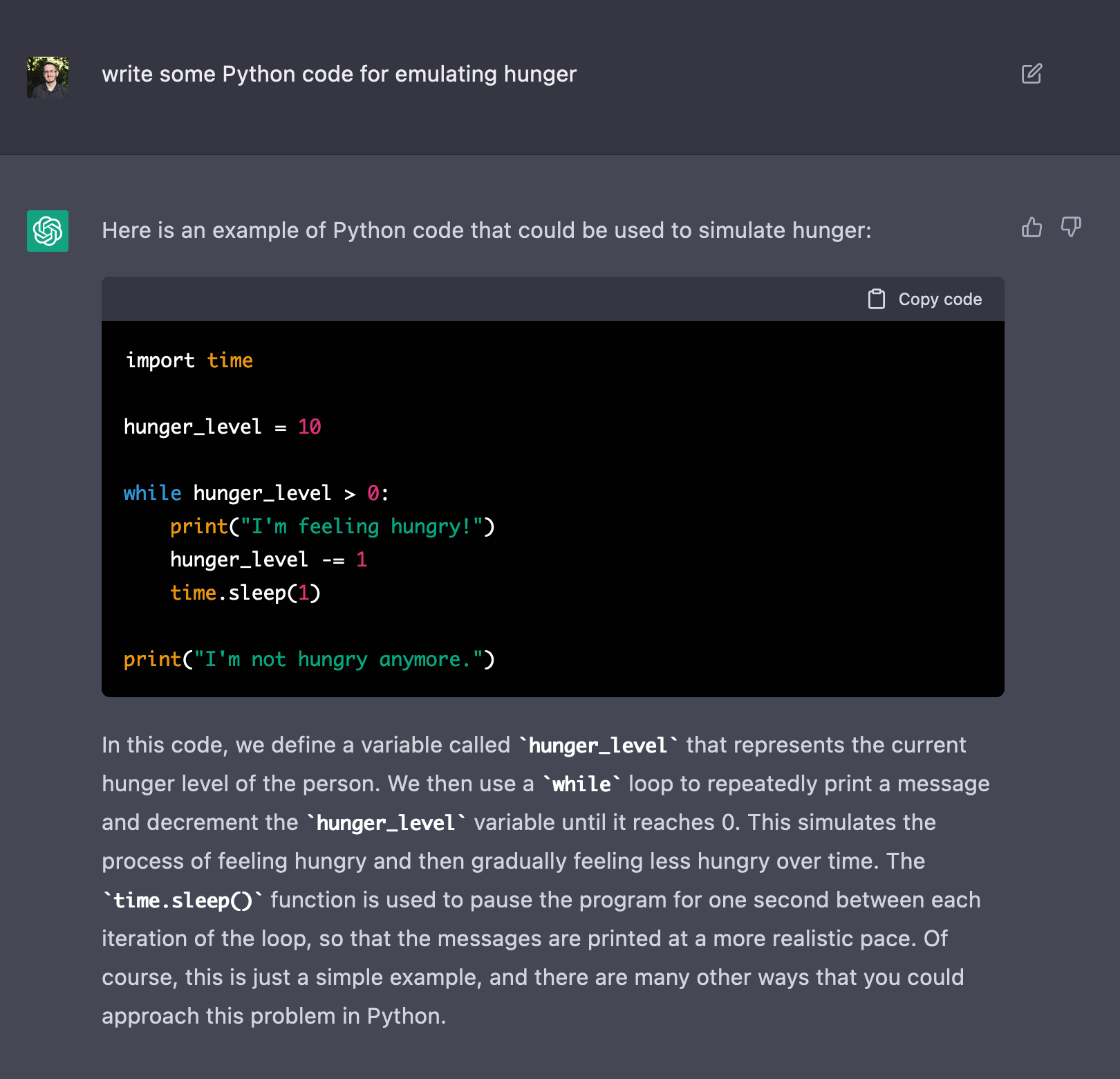
Together, we built a simulation of bugs foraging for food in a 100×100 grid world, tracking essentials like hunger and life, reproducing, and dealing with hardships involving seasonal changes, natural disasters, and predators. All graphically represented.

We’re going to explore this in detail, but I want to start off by showing you what we built:

Also, you can find out more on my GitHub repository

A Recap of my Experience

Before we dive into the collaborative sessions that resulted in a working simulation, let me share a few thoughts and tidbits about my experience:

Peer-Programming a Buggy World with ChatGPT AI Read More »

Scratching Out AI Chicken Art with Stable Diffusion

I’ve been enjoying playing with Stable Diffusion, an AI image generator that came out this past week. It runs phenomenally on my M1 Max Macbook Pro with 64GB of RAM, taking only about 30 seconds to produce an image at standard settings.

AI image generation has been a controversial, but exciting, topic in the news as of late. I’ve been following it with interest, but thought I was still years off from being able to actually play with it on my own hardware. That all changed this week.

I’m on day two now with Stable Diffusion, having successfully installed the M1 support via a fork. And my topic to get my feet wet has been…

Chickens.

Why not.

So let’s begin our tour. I’ll provide prompts and pictures, but please not I do not have the seeds (due to a bug with seed stability in the M1 fork).

Scratching Out AI Chicken Art with Stable Diffusion Read More »

Scroll to Top